by Audrey Carroll
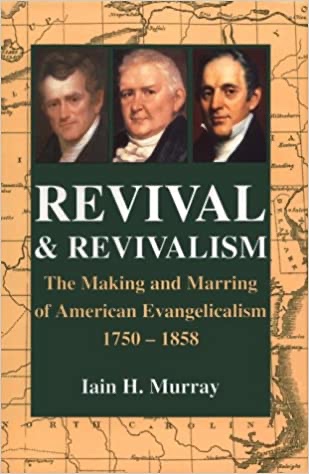
Revival & Revivalism: The Making and Marring of American Evangelicalism by Iain H. Murray is a historical-nonfiction read about evangelicalism and its movements throughout early colonial America. This book has been staring me down from the top of the bookshelf for the last couple of years, and I have finally pulled it down. I’m glad that I did.
I’ve been seeing a lot of prayers for revival on Facebook. Many of my friends have commented on our current social climate and how it’s “ready for revival.” Murray’s book has helped me understand what true revival is and the warning signs of false revival.
Defining our Terms
What is revival? Revival is marked by a great conversion that accompanies the preaching of the Word. It is followed by “purity and abiding fruit” (Murray 163). In other words, revival is a good gift from God.
What is revivalism? Revivalism is measured by the strength of emotions. These emotional surges are considered to be direct acts of God (163). In other words, revivalism is a weak attempt of man to play God.
True Revival is not…
- Against reformation. Many in revivalism wanted to see a great wave of sinners converted. But they did not want to be challenged in their own beliefs (180). The true revivalists wanted their own congregants to be challenged by the Word as much as those outside of the church. Those who were afraid that their beliefs would be challenged were instrumental in the promotion of revivalism. True revival, on the other hand, must be composed of change: repentance of sin and realignment with Scripture. True revival is marked by a reforming and reshaping of lives in accordance with the Word of God. Those who say “Well, that’s just what I believe” would not handle true revival well.
- Disorderly. Revivalism is marked by an outpouring of emotions. It is often shown through the “falling down of multitudes” and “crying out” (165). However, this disorder contradicts God’s character that we see in Scripture. God is very orderly. One great example of this is the sin of Nadab and Abihu in Leviticus 10. These two men offered incense to God “which He had not commanded them” (Leviticus 10:1). As a result of their folly, they were struck dead. They had failed to worship God in the orderly way that He had clearly given them in the Old Testament Law. And this order is not abolished in the New Testament. Jesus said in Matthew 5: 17-18: “Do not think that I came to abolish the Law of the Prophets; I did not come to abolish but to fulfill. For truly I say to you, until heaven and earth pass away, not the smallest letter or stroke shall pass from the Law until all is accomplished” (NASB). This is not to say that we must keep the Law in order to obtain salvation. Instead, this shows us how serious God is about keeping His Word. In fact, He always keeps His Word. And by trusting in the perfect and completed work of Christ, we may be saved.
- Psychological. You’ve seen the various methods for “winning someone to Christ.” You may be surprised to know that these methods are not new. They focus on creating the “perfect circumstances” for the unbeliever to be saved. This resulted in the infamous alter call. The alter call was created in the early 1800s. Its initial justification “was that by bringing individuals to identify themselves publicly it was possible for them to be prayed with and to be given instruction” (Murray 186). Soon, these alter calls were regarded as genuine conversion. These calls were, of course, performed under incredibly manipulative circumstances. By preying on heightened emotions, these preachers were able to claim great numbers. They considered it a win-win. The church’s numbers won, the presiding preacher won, but the convert lost any hope of being fed the Word. This great evil still happens today.
True Revival is…
- Focused on God’s Word. Throughout Scripture, Jesus performed many miracles. But these miracles always had a purpose: to teach the Scriptures and to show how He is the perfect fulfillment of them. The miracles were not to merely amaze people. Jesus’ actions were guided by the Word (for example, see John 15:21-28). Similar to this concept, Paul writes in Romans 10:14 and 17: “…How will they believe in Him whom they have not heard? And how will they hear without a preacher? So faith comes from hearing, and hearing by the word of Christ” (NASB). No one may be converted apart from the preaching of the gospel according to the Word of God. Revivalism is provoked by the emotional and repetitive singing of songs (Murray 165), but revival is provoked by no one other than God Himself upon the preaching of His Word.
- About looking within (instead of looking without). Many mistakenly believe that revival is only about conversion. This is a wrong assumption. Revival is equally for the good of the believer. In fact, revival must first happen in the heart of the believer. Remember that true revival is not against reformation? So the believer must allow himself or herself to be actively challenged by the Word of God. We must all pray that God would do this work in our hearts whenever we come before His Word. We must ask: Am I coming to the Text with my beliefs at the forefront of my mind? Or am I allowing the Word to challenge me and change me? The latter can only come about through the Holy Spirit. Do not look solely to unbelievers in anticipated times of revival. Pray that God would do a work in your own heart so that He may use you to spread the gospel.
- About God’s glory. Many on the revivalism side of the fence were anxious for revival because it looked good. It reflected well on their preaching style. It reflected well on their methods for growing the church. In other words, revivalism is focused on man. True revival, on the other hand, offers glory to no one but God. It is His Spirit that brings about His work according to His Word. Man is merely the instrument that He uses to teach His Word (“…How will they hear without a preacher?” Romans 10:14b NASB). There is no new teaching (Murray 170). There is no fresh message. The only words we need have already been given to us. They have been breathed by God Himself and are “profitable for teaching” (2 Timothy 3:16-17). How dare we want anything more. How dare we attempt to claim even part of God’s glory as our own.
In the End
This book has caused me to evaluate myself. Too often, I fail to ask the Lord to genuinely do a work in my heart. I need Him to constantly realign my heart to His Word. I also need Him to equip me for the spread of the Gospel. I often miss opportunities because I am selfish, stubborn, and prideful. If God sees fit to once again bring about a great revival in America, the people of God must be saturated in the Word of God so that we are thoroughly equipped to do the work of God in obedience to the will of God.
If you want to read Revival & Revivalism for yourself, click here to view the book on Amazon.

 Corinth Baptist Church