by Jeremy Shultz
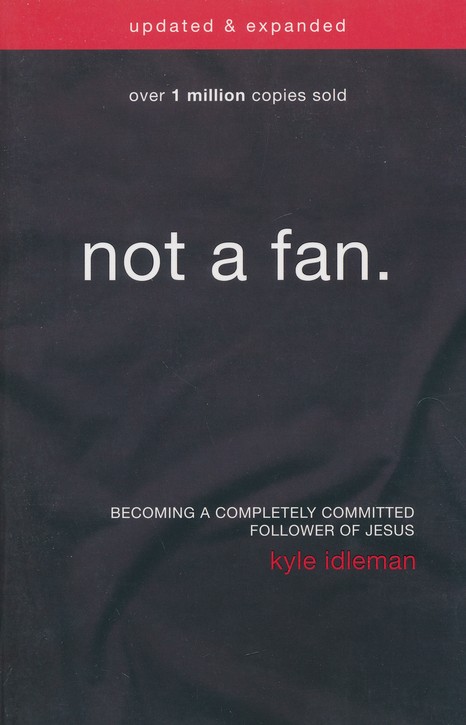
Not a Fan begins with a prologue which explains the author’s premise for the book. Kyle Idleman is the pastor of a large church in Louisville, Kentucky who is sitting in an empty sanctuary on the Thursday before Easter trying to come up with an engaging sermon for his congregation. He is expecting a large crowd for the Easter service including several people who only attend church on Christmas and Easter. He really hopes to be able to “wow” the Creasters (as he calls them). He asks himself, “What could I say to get their attention? How can I make my message more appealing? Is there something creative I could do that would be a big hit and get people talking?”
In his frustration, he decides to find inspiration for his sermon by looking at the sermons that Jesus preached when he had a large crowd. He lands in John chapter 6 when Jesus was addressing a crowd of at least 5000 people. We can all recall the story as we have, no doubt, heard it hundreds if not thousands of times where Jesus feeds the 5000 people with a few loaves of bread and a couple of fish. The part of the story that we don’t often hear is what transpired the following day. After all of the people had their fill and lied down to rest for the evening, they wake the following morning to find that Jesus and his disciples are nowhere to be found and have crossed over the scene to the other side. The crowd also makes their way over to the other side in order to ask Jesus why he left. Perceiving their true intentions, Jesus tells them: “Truly, truly I say to you, you are seeking me, not because you saw signs but because you ate your fill of the loaves. Do not work for food that parishes but for the food that endures to eternal life which the Son of Man will give to you” -John 6:26-27 ESV. Jesus then ends his sermon by explaining that he is, in fact, the bread and that if anyone eats of his flesh and drinks of his blood, they will have eternal life. Now rather than offering them physical sustenance which only satisfies for a short time, he only offers them spiritual sustenance which will satisfy eternally. The question that this crowd is left with is “Is Jesus enough?” This narrative ends sadly with many of his disciples turning away and no longer following him (John 6:66).
After reading this passage, Idleman’s heart is broken. He laments: “I think over the years my intentions were good; I wanted to make Jesus look as attractive as possible so that people would come to find eternal life in him. I was offering the people Jesus, but I was handing out a lot of free bread. In the process, I was cheapening the gospel.”
The body of the book is divided into three parts. Part 1 begins by asking the question are you a “fan or a follower?”, and helping us define and better understand these terms. He begins with asking us to D.T.R (“define the relationship”) with Jesus or as Paul would say, “Examine yourself to see that you are in the faith” (2 Corinthians 13:5a).
What is a Fan?
Idleman’s working definition for fan is this: an enthusiastic admirer. He describes this person like a football fan who is sitting in the stands and cheering, but doesn’t actually play the game; or a woman who follows celebrity news closely and stays up-to-date with the various minutia of her favorite stars, but she doesn’t actually intimately know any of the people that she follows. Idleman says, ”And I think Jesus has a lot of fans these days. Fan to cheer for him when things are going well, but who walk away when it’s a difficult season. Fans who sit safely in the stands cheering, but they knew nothing of the sacrifice and pain of the field. Fans of Jesus who know all about him, but they don’t know him” (Ch 1).
What follows is a series of questions to aid in diagnosing whether you are a follower or just a fan. He follows each question with a biblical example of a character who encounter Jesus and had to answer these questions for themselves.
- A decision or commitment?
- Knowledge about him or intimacy with him?
- Following Jesus or following the rules?
- Self-empowered or spirit filled?
Come and Die?
Once the relationship with Christ has been established—indeed the reader has decided to follow Christ rather than just be a fan of him—Idleman exegetes Luke 9:23 in order to describe what following Christ actually entails: “And he said to all, ‘If anyone would come after me let him deny himself and take up his cross daily and follow me’” (Luke 9:23 ESV). An entire chapter is dedicated to each phrase in this verse. These chapters are then followed with a personal testimony from friends of the author. Each person details where they were in their life prior to encountering Christ and then how drastically their life has changed after they have decided to follow him.
Discussion
I originally read this book back in 2011. Admittedly, I spent the majority of my “spiritual time” reading Christian books and very little of my time actually reading Scripture. When I originally picked up Not a Fan and read it, I was blown away by Idleman’s humility and candor in describing his own struggles and shortcomings. I found each of the testimonies to be quite touching and encouraging. His message of relentlessly pursuing Christ rather than just remaining a fan was quite convicting. Since reading this book I have “examined myself to see that I was in the faith” multiple times. This book and its message have no doubt been used in my own life for my sanctification.
However, my most recent reading of this book in the last couple weeks has also troubled my heart. While the author does exegete Scripture appropriately and his gospel message is orthodox, there was very little mention of grace. The word “grace” is only used 21 times in this book. While that does not initially raise any alarms, the majority of these refer to God’s grace in his invitation for us to follow him and not God’s grace to aid us in following him. The major emphasis of Idleman’s message is, “You need to decide to follow Jesus, you need to be more committed, your devotion to Christ is lacking…” and so on. After finishing this book, I find myself quite depressed at my own inability to follow Jesus as closely and as devoutly as I would like. I find myself crying out to God just like the man in Mark 9, “I believe, help my unbelief.” While Jesus clearly calls us to deny our self, take up our cross, and follow him he also calls us to “Come to me all who labor and are heavy laden and I will give you rest” (Matthew 11:28 ESV).
Secondly, I disagree with the motivation Idleman gives for following Christ. The author encourages us to follow Christ because he first loved us. While I don’t disagree that Christ’s work on the cross in order to save my sinful soul is more than enough motivation to take up my cross and follow him, I would like to see Idleman spend more time focusing on God’s glory and majesty. There is a common theme among the testimonies that at the end of each chapter. Much attention is given to what kind I’ve trouble the person found themselves in, how they were introduced to Jesus, and then how their life is better now that they have decided to follow Jesus. There is no doubt that Jesus did come to save us and heal us from our sins, but we are not the main character in the story of redemption, Jesus is. While Jesus’ work on the cross can and will cleanse us from all unrighteousness (1 John 1:9), it is also to maintain God’s character: so that he could be both just and the justifier, both holy and merciful, both righteous and gracious (Romans 3:25-26). Our commitment to follow him should be based on both who he is and what he has done. We cannot allow ourselves to only focus on one of these. It would be very easy to come away from this book and expect a “quid pro quo” relationship with God; if I follow him close enough, he will make my life better. No doubt, the blessings that come from following Christ are immeasurable, but this truth has been twisted into heresy via the increasingly popular prosperity gospel. Though Idleman is careful to fully denounce the prosperity gospel (calling it “Snuggie theology”), I would like to see him spend more time encoring his readers to follow Christ because of what he has done AND who he is.
The Long and Short of It…
- Is this book biblical/orthodox? Yes.
- Is it a good read? Yes.
- Is it helpful? Yes.
Click here if you’re interested in reading Not a Fan for yourself.

 Corinth Baptist Church