by Jordan Hoge
Biographical Sketch of the Author
Dr. Steven W. Smith is a credentialed pastor, academic, and author. Dr. Smith is the Senior Pastor of Immanuel Baptist Church in Little Rock, Arkansas. He is known well for his skillful preaching and as a teacher of today’s preachers. Dr. Smith currently serves as a professor of Preaching and a Senior Preaching Fellow at Midwestern Baptist Theological Seminary in Kansas City, Missouri.
Summary of the Book
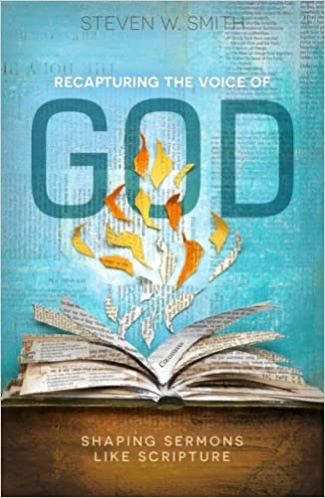
Dr. Smith defines text-driven preaching as the interpretation and communication of a biblical text in a sermon that re-presents the substance, structure, and the spirit of the text (Smith, 17). In his book, he uses what he calls “re-presentation” to convey the manner by which preachers must faithfully re-present God’s word in their preaching today. The chapters of this book are composed of instructional means of preaching regarding the specific genres found within the Bible. By explaining the proper ways to preach each genre of Scripture, Dr. Smith helps today’s preachers by revealing the way preachers must preach the Scriptures in the very same manner that the Holy Spirit inspired the Scriptures. By shaping their sermons in the same manner as the original text, preachers today can re-present the same message intended by the original authors (Smith, 7).
In his book, Dr. Smith focuses a great deal upon the voice of God and the preacher’s voice as resembling the voice of God. This means that the preacher has a responsibility to capture the pitch, rate, and volume of God’s voice as revealed in the pages of Scripture by presenting the passage in a way that is driven by the nature of the text itself (Smith, 15). Dr. Smith’s primary argument involves the preacher’s preaching in the voice of God by accurately re-presenting the substance, structure, and spirit of the text as noted above. When reading the whole of Scripture, one will hear God’s voice in various genres. As you may guess, God’s voice is presented in a variety of ways because there are sixty-six books of various genres, cultures, and circumstances. Dr. Smith questions, “If God changes his voice, shouldn’t we preachers change ours?” (Smith, 7).
To accomplish the task of putting forward the “substance,” the preacher must have a deep understanding of the individual book from which he is preaching within light of the whole Bible. Dr. Smith gives a great deal of attention to preaching on the “macro-level” and the “micro-level.”. By preaching the “macro-level,” the preacher seeks to understand where the passage fits within the context of the whole Bible. By preaching the “micro-level,” the preacher zooms in and drills down so that he can faithfully exegete (draw out the meaning of the text) the details of the passage before him (Smith, 18). For example, Dr. Smith writes that the Epistles have a microstructure because there is so much truth found in so few words (Smith, 182).
Dr. Smith also provides a great deal of instruction for structuring each individual sermon in a way that most accurately communicates the sermon’s text. For example, while preaching a narrative text, Dr. Smith recommends an inductive manner of preaching: to fully unfold the narrative of the passage for the congregation. The narrative portions of Scripture were written as a story for a reason. While the meaning of the passage can be found at the micro-level, the meaning is primarily found within the narrative itself. Therefore, by understanding literary features such as plot and character development, the preacher will see the message truly unfold in the narration (Smith, 43). Another example Dr. Smith brings to light involves preaching Old Testament prophetic writings. He holds that preachers should often re-present the sermon structured by most natural divisions of the text within the strophes that act like “points” of the text (Smith, 173). As the text most naturally divides, so also the sermon’s divisions should divide for the message to re-present the original message most faithfully.
By faithfully re-presenting the voice of God through the original substance of the text and by carefully structuring the sermon according to the natural divisions of the text before, the preacher will then most faithfully convey the spirit of the Bible. It is this re-presentation of the spirit of the text that the preacher should aim to put before God’s people week after week, and by doing so, God will be glorified as His people hear His voice through the preacher’s voice.
Critical Evaluation
This book is helpful because it clearly communicates what it means for the preacher to faithfully deliver a sermon in the manner that most faithfully communicates God’s word. While Dr. Smith advocates for careful and sound exegesis, this book focuses upon preaching from an angle that is not discussed as often in preaching textbooks. Instead of focusing upon the minute details of Biblical languages and language structures, he focuses upon re-presenting the word of God from a structure-based angle. Therefore, this book is unique in that it gives great detail in an area of preaching that is often overlooked.
Over the course of years, preachers preach through various genres of Scripture. Preachers will likely refine their preaching styles, their homiletical structures, down to what seems to work best for them individually. However, Dr. Smith says that this type of preaching will quickly become predictable, and most importantly, this type of preaching is not most-faithful to God’s word. If the preacher compares an old sermon outline for an Epistle to an old sermon outline for an Old Testament narrative, and they look very similar, he needs to read Dr. Smith’s book. Dr. Smith helps preachers understand that Old Testament narratives should not be preached in the exact manner New Testament Epistles should be preached. Prophetic poetry and parables are extremely different genres; therefore, they won’t fit best within the same type of sermon outline. Dr. Smith’s book reveals that the temptation for preachers to preach every sermon the same way must be destroyed because it is neither healthy for the preacher’s own understanding of God’s word nor the people he’s preaching to in the pews.
Because of its unique clarity regarding a sermon’s structure, this book is a great choice for men who are careful exegetes, faithful studiers of the text, and want to grow in their ability to preach God’s word. While many preachers are comfortable with their three-point sermons based upon “micro-level” exegesis, Dr. Smith’s book challenges preachers to get out of their comfort zones by preaching passages with various structures and in various manners. The structures and manners are entirely reliant upon each individual text of Scripture rather than a preacher’s homiletical preferences.
Dr. Smith has truly given preachers a resource which is faithfully theological and practical. It is especially helpful for those who desire aid in the area of sermon delivery without compromising Biblical faithfulness. While it should not be the choice of one seeking an exegetical digest, I highly recommend this book for anyone seeking help in the area of sermon delivery.
The greatest difficulty of this book is that the truths must actually be practiced if the preacher is to gain anything from its contents. The great challenge for many preachers simply is changing the way they have always preached sermons. However, practicing Dr. Smith’s approach should only result in the growth of the preacher’s understanding of the way God has communicated to his church and the growth of the church as they hear God’s word presented in the way the original author intended.
Another great advantage to structuring sermons in Dr. Smith’s manner is that as the preacher declares the word of God to the people, the people will also grow in their understanding of the way they should individually study the Bible. By presenting the sermon in a way that resembles the passage’s original structure, listeners should be able to see a simple outline in the text. While the listeners will likely never see the sermon outline upon the pulpit, they should see the outline before them in their laps. Therefore, the preacher is able to reap great rewards by presenting God’s word while teaching the congregation how to understand the for themselves.
Form
The chapter divisions are structured around the various genres in the Old and New Testaments. In each chapter, the reader will find the following information for the specific genre cover by the chapter.
- Interpretation: Hearing the Voice of God
- Communication: Recapturing the Voice of God
- Structuring a Sermon
- Sermon Samples
Dr. Smith also provides additional information that is critical to understanding the genre individually. For example, in his chapter explaining prophecy, Dr. Smith explains the value of panning out to see immediate fulfillment and further messianic fulfillment. Because the form is organized and easy to take in, the reader is able to begin each chapter in expectation of what’s before him, but will also likely realize that each chapter has new truths because each genre has its own unique characteristics.
If you want to read Recapturing the Voice of God for yourself, click here to view the book for purchase.

 Corinth Baptist Church