by Sheila Green
PART 1: Lessons 1-3 of 9
Rich Harasick is the children’s minister at Grace Community Church in Sun Valley, California, under lead pastor John MacArthur. In 2009, Harasick began a series called “Parenting for Life” (linked below) on the church’s website. Considering the many parents within our church family, I think the topic of parenting would be a very pertinent one to study. Harasick’s nine-week study begins with a look at roles within the family.
WEEK ONE
“Parenting is not the hub of your life. It is a part of your Christian life.”
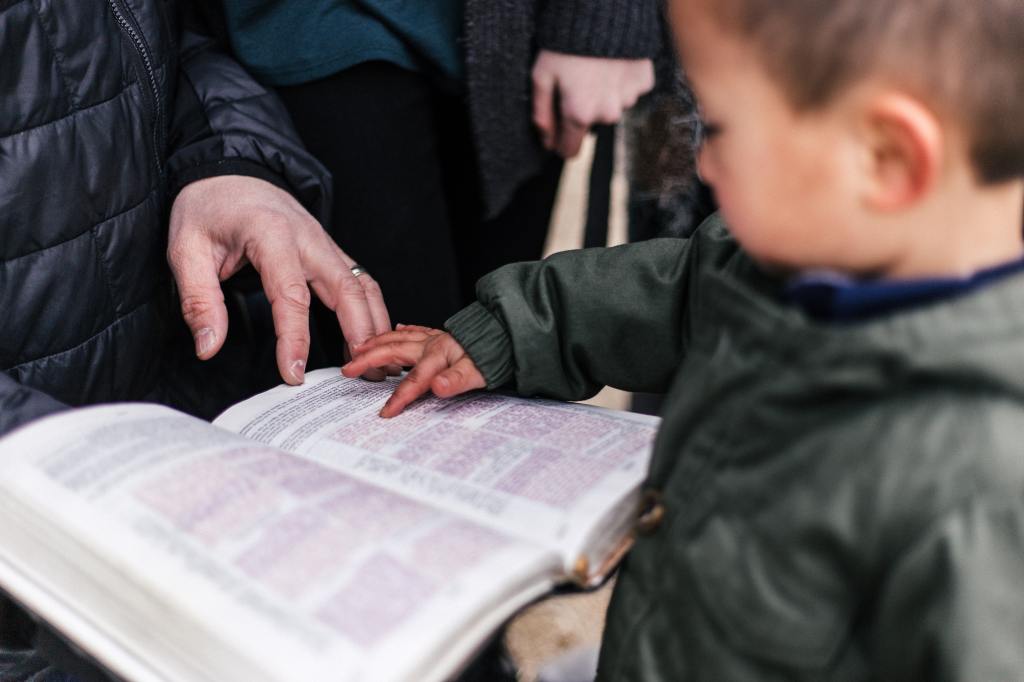
As Christians, our ultimate goal in whatever we do is to glorify our Lord and Savior Jesus Christ. Harasick says, “You are no better a parent than you are a spouse or a follower of Jesus Christ.” Successful parenting should be an overflow of our priority of following Christ and reading His Word. According to Harasick, “Biblical ignorance is at the center of family chaos and trouble.” Family Bible time should be a standard in our homes.
Roles of the family are made clear in Scripture. As parents, it is also essential that we be committed to our spouse. Marriage should be Christ-centered; likewise, family should be Christ-centered. Neither should be child-centered.
This may be a difficult concept to believe for some and difficult to apply as well. God’s design is that the husband and wife relationship is the priority in the home, and they–not the child–should set the agenda. “God has designed men and women to find their greatest fulfillment through obedience to the roles that He has sovereignly appointed to them” (Harasick). This design is made clear in Ephesians 5:15-6:4. According to Scripture, the family as a whole is subject to the father’s leadership. The father submits to the needs of his wife and children. The wife submits to the husband’s leadership–not that the wife’s thoughts and feelings are not cared about and considered. Married couples should not have different, individual agendas. Husbands are, however, accountable to God for his leadership. If men do not appropriately lead their family, the wife or children will.
Children should submit to the parents’ authority, while parents submit to the needs of their children. Parents are commanded not to provoke their children to wrath and to raise their children in love and the admonition of the Lord. Christ’s example as God’s rightful leader is to take on the role as servant. Submission in humility, thinking more of wife and children than of self, is the standard set by Christ for husbands and fathers. After all, marriage is an object lesson of Christ and the Church. The church goes off course when it has its own agenda and does not follow the leadership of Christ, the Head of the church. Likewise, families go off course when Biblical family roles are not followed.
“Wives be subject to your own husbands, as to the Lord” (Ephesians 5:22 NASB).
Submission has become a nasty word in our society. Biblical submission does not suggest a lifestyle of bondage. The husband’s role is not authoritative or domineering, neither is the wife’s. As a wife we have the greatest opportunity to teach our children what we really believe about submission to authority, friendship, affection and love. Harasick says, “Parenting is only hard to the degree that parents make it hard by failing to follow the simple principles set forth in God’s Word. Parenting is not difficult, but it’s the hardest job we have.
One of Harasick’s points that really caught my attention is that parenting is not measured by what our child does. It is actually a measure of the parent’s character. We are stewards of the blessing of children. It is important to remember that they are really His.
WEEK TWO
Discipline and instruction are not for the purpose of conforming our children to external standards of behavior. Behavior is an overflow of the heart. As parents our ultimate goal is to glorify God as His faithful instruments. After all, we cannot save our children’s souls. As parents we must teach the Word to our children and train our children to live by His standards. The convicting part of that statement is that real teaching and training shows up in our own lives. Harasick says, “More is caught than taught.” Scary thought!
We know from Scripture that man is born into depravity. As a parent, that is a tough pill to swallow about our own children (then they turn two years old, right?). However, teaching our children moral lessons and concerning ourselves with only their external behavior will only produce young hypocrites. Remember, behavior is an overflow of the heart. Teaching the philosophy that “good behavior means good kids” is to teach that our works save us. Scripture teaches that there is but one way to salvation: by trusting in Christ alone. Christian parents should be more concerned with salvation and sanctification than good behavior.
Obviously, good behavior is good for home and society. As a veteran teacher, I would say that in today’s society very little parenting happens in many homes. Many children grow up in their houses, but many are not raised there. Many parents do not understand the depravity of man. (Genesis 6:5). Harasick says, “Children are not morally neutral.”
Get ready for conviction! Harasick lists some excuses that we make for our children.
We say, “This is just a passing stage that he/she is going through.” We think, “He/she is a victim of their circumstances. He/she is tired, too young to understand, high strung, sick, shy, cute, or that other children are at fault for his/her behavior.” Perhaps we have all been guilty of at least one of these. JC Ryle said:
“If then you would deal wisely with your child, you must not leave him to the guidance of his own will. Think for him. Judge for him. Act for him, just as you would for one weak and blind, but for pity’s sakes, give him not to his own wayward taste and inclination. It must not be his likings and wishes that are consulted. He knows not yet what is good for his mind and soul, any more than what is good for his body. You do not let him decide what he shall eat or drink and how he shall be clothed. Be consistent and deal with his mind in like manner. Train him in the way that is Scripturally right and not in the way that he fancies. This is the first principle of Christian training and that self-will of the child is the first thing that appears in his mind and it must be your first step to resist it.”
WEEK THREE
Harasick suggests five words/phrases that we should use to train young children.
1. “No” should be clear and firm when directing behavior.
2. “Stop” obviously is needed when we see a young one about to harm themselves or others.
3. “Sit” should be used for increasing intervals of time. Children should not be allowed to always be running around and doing whatever they want to do.
4. “Quiet” because children should not talk all of the time. Listening is an important skill, and sometimes peace and quiet is necessary.
5. “Come here” is used to teach submission. There are times when a child needs to stop whatever they are doing and be obedient to instruction.
All skills are taught. Either good or bad habits are formed with all skills, including sleeping, eating, and being content. Of course there is a balance between instruction and discipline. Younger children require much more discipline, while older children require more instruction from The Word. Biblical discipline and instruction include spankings, encouragement, advice and warnings. Instruction should point to the character of God. There is no way to avoid evil. Children cannot discern evil; therefore, it is up to parents to prudently guide our children as they learn to navigate this world using the right attitudes and skills. It is not wise to isolate our children from bad influences throughout their lives; it is also not possible. Evil will find a way in. At some point in their lives children go out from their parents and must have the skills and attitudes to use discernment and to be prudent. Without this set of skills our children will be easy targets for Satan. Our children must learn that choices bring consequences and that “we reap what we sow” (Galatians 6:7-9 NASB). The only tool that we have to teach our children Godly living is God’s Word. We must apply standards found in His Word.
At an early age, children should sit in church. According to Harasick, parents should begin training children by at least age three (building up the time as needed). To be exposed to preaching and teaching of the Word, children must be present in church. When a child can read and write at school, they can read and write in church.
As parents we should keep the right motivation. This is not to “raise good kids.” Parental motivation in raising children is to glorify God. Our goal is not perfect children on the outside. We must teach our children to be pleasing to The Lord. This may not be the same as raising children who are pleasing to others. We should not compare our own family to other families- especially those who do not wish to serve the Savior. Obviously we should learn by observing and interacting with Godly experienced parents, but do not make other families the standard of our own family. The standard is Christ.
It is easy to be fearful as a parent. We can be fearful about many things when it comes to parenting; however, there is no better time than in parenting situations to be faithful and trusting in The Lord. Christ is our standard. Families are in all different circumstances. They have different gifts and different preferences. For example, some families use public school; some private; some home education. Some enjoy music; some sports; some farming. Biblical parenting is multifaceted, but through the reading of the Word, diligent prayer, and proper motivation we can persevere in parenting. We cannot control the heart of our child. We cannot save our child. However, it is our responsibility to teach our children The Word. “Faith comes by hearing, and hearing by the word of Christ” (Romans 10:17 NASB). It does not come any other way. Harasick says we are “the antagonist of our child’s sin and an advocate for The Gospel.” A focus on external behavior only could produce a “young Pharisee.” We must lovingly guide our children to (internally) hate sin.
All of this leads us to the conclusion that as parents we are not to simply complete a to-do list in raising “good kids.” Parenting is a wonderful opportunity to trust God. We must continually pray and ask for His Wisdom. After all, they are really His children, and He will faithfully equip us to parent.
To be continued Thursday, July 9.
If you would like to listen to this sermon series for yourself, click here.

 Corinth Baptist Church