By Tyler Robbins
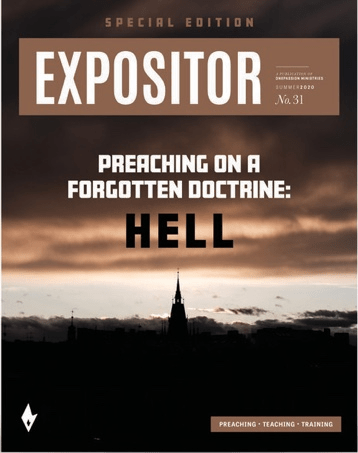
A couple of weeks ago, I heard Dr. Steve Lawson talk about Expositor Magazine on Wretched Radio with Todd Friel. Expositor Magazine is a quarterly publication from One Passion Ministries. Dr. Lawson and several other great expositors of God’s Word—including Albert Mohler, Conrad Mbewe, John Piper, Ligon Duncan, Sinclair Ferguson, John MacArthur, and more—contribute to this magazine geared toward pastors and faithful church members. Dr. Lawson decided to write this summer’s issue by himself, sharing the title of my post. Even though hell is terrifying and not easily talked about, Dr. Lawson explains to us the importance of hell and the reasons we must preach it. Please be sure to click on the links associated with the theological terms for a better understanding of the word.
HELL IS A BIBLICAL DOCTRINE
As a good expositor of the Bible, Dr. Lawson firmly believes in preaching the whole counsel of God. He will not skip or overlook any part of Scripture. Therefore, he has no choice. As he states in his first reason, “eternal punishment is a biblical doctrine that is rooted and grounded in the Word of God.” He also points out: “an expositor being called a ‘hellfire and brimstone’ preacher was once synonymous with being a Bible preacher. Today, it is considered to be a demeaning stereotype.” One might think that hell is his favorite topic to discuss. It definitely gets different emotional reactions. Maybe Dr. Lawson just likes to scare people. However, if you read this current magazine issue and consider how Scripture itself handles the doctrine of hell, you will not come to that conclusion. The doctrine of hell puts both the holiness and grace of God into the right perspective.
HELL MAGNIFIES THE CROSS
Another one of his seven reasons given is hell magnifies the cross. Whether we have been believing on the Lord Jesus Christ for several decades or only several days, we have to constantly be reminded of the cross that made our salvation a reality. The fact that Christ suffered in His death for sinners is magnified as we consider what He endured upon the cross. As Dr. Lawson states, “only damned souls now in hell can begin to grasp something of the awful agony that Jesus suffered as He bore the wrath of God in our place.” For believers in Christ, Jesus’ death on the cross was the ratification of a new covenant with God’s people. Because the Lord Jesus took the full wrath of God, in the place of the sinner, the cross cannot be remembered too often.
HELL PROMOTES SANCTIFICATION
Dr. Lawson also reminds us that hell promotes sanctification. To sanctify something is to set it about for special use. When someone believes the Lord Jesus and repents (a change of mind that results in a change of action) of their sin, they are instantly saved from God’s eternal wrath in hell. The process of sanctification continues throughout the earthy life of the believer. Dr. Lawson states, “God uses hell to cause believers to have an utter disdain for the same sins that condemn others.” The believer can no longer enjoy the sin they were enslaved to in light of its consequences. Steve continues, “acts of sin appear more hideous and repulsive when seen in light of hell.”
After this introduction, the rest of the magazine focuses on what Scripture tells us about hell. The Old Testament doesn’t really say much about hell. Like other major doctrines, the Old Testament gives us a veiled glimpse of what is fully revealed in the New Testament. Dr. Lawson tells us “this gradual unfolding of doctrinal truth is known as progressive revelation. That is, truths stated in the Old Testament are increasingly enlightened over the 1,600 years it took to write the Bible. What is dimly stated in the Old Testament receives a much clearer and more fully developed treatment in the New Testament.”
The PSALMS
“You have rebuked the nations, You have destroyed the wicked; You have blotted out their name forever and ever. The enemy has come to an end in perpetual ruins, And You have uprooted the cities; The very memory of them has perished.” Psalm 9:5‒6 (NASB)
Clearly, even the Old Testament writers understood the eternality of hell. Here, Dr. Lawson defines the words in Psalm 9:5-6 that prove,
When David says in verse five that the destruction of the wicked will be “forever” (Hebrew: olam), he uses a word that means “always, perpetual, everlasting.” He adds “ever” (Hebrew: ‘ad), which means “perpetuity, continuous existence.” Joining the two words together—”forever and ever”—means “an endless occurrence of the wicked being destroyed.” In verse six, David further uses the word “perpetual” (Hebrew: nesah), which means “enduring continually unto the end.” Here, David reinforces the never-ending punishment of the wicked. The clarity of these words simply cannot be overstated.
The Prophets
When a prophet would speak for God, it was almost always a precursor to God’s judgment. The western mind will have trouble getting a grasp on what the prophets of God had to go through. It would be a very tough ministry to have to proclaim the coming judgment of God, especially when God told you that nobody would believe and repent. Like the Psalmist, the prophets knew that the wrath of God would be experienced throughout eternity. Dr. Lawson sites several verses, including
“Then they will go forth and look on the corpses of the men who have transgressed against Me. For their worm will not die and their fire will not be quenched; And they will be an abhorrence to all mankind.” Isaiah 66:24 (NASB)
“Many of those who sleep in the dust of the ground will awake, these to everlasting life, but the others to disgrace and everlasting contempt.” Daniel 12:2 (NASB)
Even though the Old Testament does not speak of hell that often, Dr. Lawson reminds us, “Scripture only needs to state a truth once for it to stand true for all time.”
The New Testament
The majority of this magazine is dedicated to the New Testament development of the doctrine of hell. This section is packed full of Scripture references that serve as a vivid warning of what hell is like and who will be spending eternity there. Dr. Lawson also reminds us, “The words of Jesus, as recorded in the four Gospels, comprise a total of 1,870 verses. Thirteen percent of those are about judgment and hell. In fact, Jesus had more to say about these two subjects—the final judgment and eternal hell—than any other topic about which He spoke”. Steve also notes, “Jesus never gave the impression that hell is a state of mind or mere allegory. He claimed it is an actual place into which the unrepentant human body and soul are cast”.
The final article in this magazine deals with what Satan wants us to believe about hell. Dr. Lawson unpacks a few of the lies that are believed today. It is very important for us to continually learn the Word of God as it has been given to us. We can’t allow our minds to be pulled away from God’s complete revelation to us, including the doctrine of hell.
This is the first issue of this magazine that I have read. I am looking forward to another issue.
If you would like to subscribe to Expositor Magazine, click here.
If you would like Issue 31 entitled Preaching on a Forgotten Doctrine: Hell, click here.

 Corinth Baptist Church