By Audrey Christensen
What’s your first reaction when someone mentions meditation? Maybe you recoil, roll your eyes, or awkwardly avoid that person for the rest of your life. Until recently, I would have had a similar reaction to any mention of meditation.
This summer, our Fort Worth church’s women’s ministry is studying through God’s Battle Plan for the Mind: The Puritan Practice of Biblical Meditation by David W. Saxton. So far, the experience has been incredibly educational, prompting me to spend more time in true Biblical meditation, which has greatly improved by daily Bible study practices.
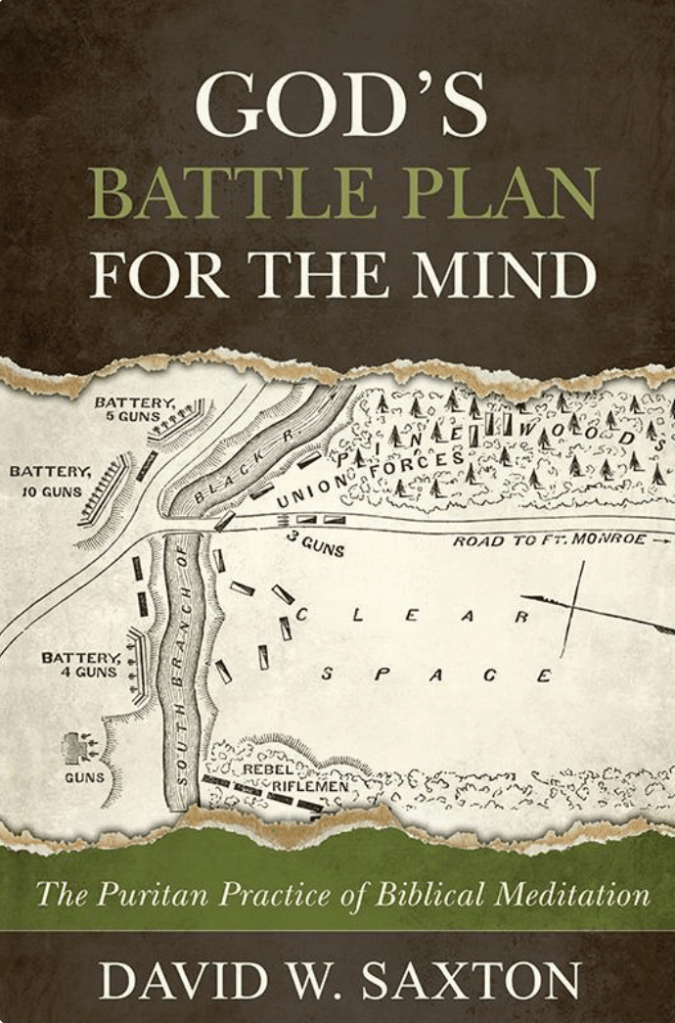
Thankfully, early on in the book, Saxton qualifies unbiblical meditation, stating that some “counterfeit kinds” of meditation include Roman Catholic spirituality, mysticism, contemplative prayer (which Dad mentioned in a previous blog post he wrote here titled “Christian Meditation”), transcendental meditation, yoga, far Eastern religion, and meditating on evil or lesser things (17-22). First and foremost, meditation is an inherently Biblical practice (see Psalm 1:2 and 119). Any other meditative practice is an appropriation of what the Lord created to be a beneficial practice for His people in relation to Him. Because of this, any time we combine worldly practices or the practices of other religions with meditation, we are giving in to a kind of syncretism. Think about it this way: it would be very odd if you sat down to your daily Bible study and opened up your time with an episode of Phineas and Ferb, the message of which is “you can do anything you set your mind to.” Sure, that’s a positive message, but it ought not be mixed with Bible study. The same is true for meditation. We must quiet our hearts and minds, but nowhere Scripture commands to sit cross-legged, pointer fingers poised to thumbs. Saxton appropriately notes, “Puritan tradition emphasized imagination much less” (18).
In the New Testament, meditation is rendered as “a key aspect for the godly renewing of the mind. It is also used as a primary means to comfort and encourage Christian perseverance” (29). Meditation is a very practical thing. Indeed, it is good to read Scripture. We must read lots of Scripture. But if we are not faithful to dwell on it, consider it, ponder it, set our minds and affections on it, and remember it, it is serving us far less than the Lord intended. Saxton likens it to eating an entire meal without tasting any of it. Ultimately, it comes down to the simple question: Do we prize the Word of God? The source of meditation must be true (Scripture). The object of meditation must be good (God [see Philippians 4:8]). The frequency of meditation must be often. And the result of meditation must be sanctification.
There are countless enemies of Biblical meditation. Besides syncretistic practices, everyday distractions likely run amuck in your spiritual life just like they do in mine. Laziness, procrastination, chores, or a million other things may keep you from spending time reading the Word. But be aware of the other countless distractions that prevent you from fully benefiting in the plentiful offerings of Scripture. One way that I have tried to more regularly implement Biblical meditation is while I’m cooking. It’s really easy for me to put on a YouTube video in the background, but I find it’s far more beneficial for me to instead spend that time praying, reciting Scripture, or even singing hymns. If I’m being extra careful of the things I’m spiritually consuming, I must be just as careful to guard those truths and actively hide them in my heart.
While I still stand behind the last blog post I wrote here, “Why are Quiet Times Important?”, I regret that I left out the crucial element of meditation. Quiet times are definitely times of active meditation, or “deliberate meditation” as Saxton puts it, but I need to grow in my practices of constant meditation. I need to let the Word of God pierce my heart, continually change it, and shape it more perfectly into the image of our good Savior.
While I’m not quite finished reading Battle Plan, I would (so far) absolutely recommend it to everyone. The book is considerably short, very easy to read, and very practical. If you’d like to get your own copy, you can buy it here on Amazon.
Neither Corinth Missionary Baptist Church nor its review authors are affiliated with or sponsored by the companies or products reviewed. No compensation has been received for these reviews. All opinions expressed are those of the author.

 Corinth Baptist Church